Are AI-Written Articles Inferior? Quality Is the Only Standard
I Posted an Article and Got Some Feedback
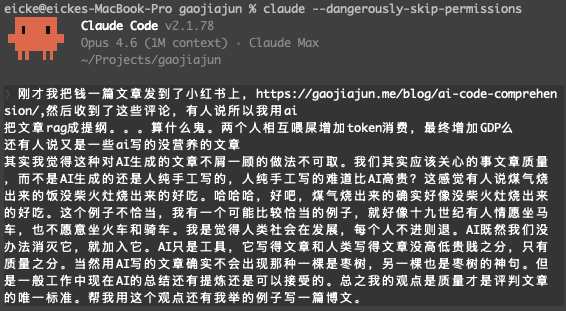
I shared an article on Xiaohongshu (China’s Instagram-like platform) yesterday, and the comment section quickly attracted a few self-appointed “authenticity inspectors”:
“So you use AI to RAG an article into an outline… what the hell is that? Two people feeding each other garbage to burn through tokens and boost GDP?”
“Just another one of those worthless AI-generated articles.”
Honestly, these comments didn’t make me angry. But I think the mindset behind them is worth discussing.
”AI-Written” Has Become an Original Sin
Have you noticed? “AI-written” is becoming a new type of pejorative label.
No need to read the content. No need to evaluate whether the arguments hold up. No need to consider whether the information is valuable. Just label it “AI-written” and you can dismiss it entirely. As if “human-written” is itself a quality certification, and AI involvement automatically downgrades the content.
But think about it — isn’t this logic a bit strange?
Whether an article is good depends on whether its insights are sharp, its evidence is solid, and whether it’s useful to the reader. When did these standards get replaced by “who wrote it”?
Gas Stoves and Wood-Fired Stoves
My first instinct was to reach for an analogy: it’s like saying food cooked on a gas stove doesn’t taste as good as food from a wood-fired stove.
But then I thought about it — okay, wood-fired food might actually taste a bit better. The smoke from burning wood adds an extra layer of flavor. Not the best analogy.
But I have a more fitting one.
Horse Carriages and Trains
In the early 19th century, when trains were first invented, many people resisted them. They felt horse carriages were more elegant, more dignified. Trains — those smoke-belching iron beasts — were crude, noisy, and beneath them. Some “experts” at the time even argued that traveling at train speeds would cause suffocation (they really did say this).
Some aristocrats would rather endure days of bumpy carriage rides than spend a few hours on a train. In their minds, the “status” of the transportation mattered more than its efficiency.
Looking back, this stubbornness is obviously absurd. We judge transportation by safety, speed, and comfort — nobody says “this vehicle is horse-drawn, therefore it’s nobler.”
The same logic applies to judging writing.
AI Can’t Write “One Was a Jujube Tree, and the Other Was Also a Jujube Tree”
I’ll admit that AI-written content has its limitations.
Lu Xun wrote: “In my backyard, you can see two trees beyond the wall. One is a jujube tree. The other is also a jujube tree.” This seemingly redundant sentence is actually loaded with emotional tension — AI almost certainly can’t produce something like this. AI optimizes for efficient information delivery, not literary subtlety and resonance.
AI would also struggle to write something like “Has it always been so? Then is it right?” — a single line that hits you in the soul.
But here’s the thing: the vast majority of what we read every day doesn’t need that kind of literary quality. When you read a technical analysis, an industry observation, or an experience summary, what you care about is: Is the information accurate? Does the analysis make sense? Is it useful to me? On these dimensions, AI already performs quite well — often even more clearly and systematically than human writers.
If You Can’t Beat It, Join It
AI is here, and it’s not leaving.
This isn’t about whether you like it or not. Just as the internet arrived — you could choose not to go online, but the world wouldn’t stop for you. Trains arrived — you could keep riding your horse carriage, but you’d fall further and further behind.
Human society keeps advancing. You either move forward or fall behind. Instead of spending energy “authenticating” whether an article was written by AI, spend that energy judging whether the article is correct and valuable. The former is prejudice. The latter is actual critical thinking.
Quality Is the Only Standard for Judging Writing
My view is simple:
Whether an article is good depends on its quality — not whether a human or AI wrote it.
A bad AI-written article is a bad article. A bad human-written article is also a bad article. A good AI-written article is a good article. A good human-written article is also a good article. The production tool doesn’t determine the product’s quality — what determines quality is the thinking, judgment, and standards behind it.
Writing with AI is like writing with a computer. Nobody says your article has no soul because you used Word instead of a fountain pen. By the same logic, an article shouldn’t be sentenced to death just because AI was involved.
Of course, if you use AI to mass-produce garbage content for clicks, that absolutely deserves criticism. But that’s not AI’s problem — it’s the person using AI. A kitchen knife can cook dinner or cause harm; you wouldn’t ban kitchen knives because of it.
Final Thoughts
Back to those comments.
To the person who said “two people feeding each other garbage to burn tokens” — I understand your concern. There really is a lot of low-quality content recycling in the AI ecosystem. But dismissing everything AI touches with one sweeping judgment isn’t critical thinking. It’s intellectual laziness.
To the person who said “just another worthless AI-generated article” — I welcome you to point out specifically what’s worthless, which arguments don’t hold up. If you can offer a valuable rebuttal, whether you thought it up yourself or had AI help you organize it, I welcome that too.
After all, quality is the only standard that matters.
Here’s the AI Prompt I Used to Generate This Article