
Sam Altman Thanks Coders, Coders Aren't Having It — Now What?
Sam Altman’s “Gratitude”
Yesterday, OpenAI CEO Sam Altman posted this on X, and it went viral:
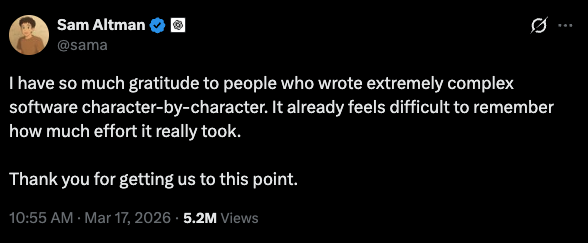
The message: “I have so much gratitude to people who wrote extremely complex software character-by-character. It already feels difficult to remember how much effort it really took. Thank you for getting us to this point.”
5.2 million views. The replies exploded.
But the reaction wasn’t “thanks for the recognition.” It was more like:
“So you’re grateful we built the thing you’re using to replace us?”
“This is like the butcher thanking the pig for its sacrifice.”
“Thank you for your service. Now please leave.”
Harsh? Sure. But understandable.
The Anger Is Real
Over the past year or two, many programmers have lost their jobs because of AI. In both the US and China, hiring is shrinking, teams are being cut, and junior positions are disappearing. This isn’t internet drama — it’s real life for a lot of people.
The reason Altman’s tweet hit such a nerve is that it touched on a raw emotion: you say thank you with your words while replacing us with your product.
That anger is completely valid. If I watched a decade of hard-earned skills being rapidly caught up to by a tool, I wouldn’t feel great either.
But Trends Don’t Care About Our Feelings
Valid or not, we have to face a reality: this is probably the trend.
We can complain — but that’s probably all we can do.
It’s like cars replacing horse-drawn carriages. Coachmen could be furious, they could protest, they could petition. But cars didn’t stop evolving because coachmen were unhappy. The Industrial Revolution didn’t stop because textile workers smashed the machines. Every technological shift reprices someone’s skills.
AI’s impact on programming is just the latest version of the same story.
The difference is that this time, it’s our turn.
If You Can’t Beat Them, Join Them
But there’s another side to this story.
Today’s AI is nowhere near the point where it doesn’t need human involvement. If you’ve used AI to write code, you know: it can produce decent-looking code, but in complex scenarios, it frequently needs a human to review, adjust, and correct.
Pure AI output is far worse than human + AI.
An engineer who understands the business and the architecture, armed with AI tools, can multiply their output several times over. Meanwhile, someone with no technical background asking AI to write code will get stuck the moment things get even slightly complex.
What does this mean? It means that right now, human experience and judgment are still the critical variable. AI is an amplifier — but it amplifies the abilities you already have.
So instead of complaining that AI stole our jobs, why not embrace it and make it our tool? If you can’t beat them, join them — that’s not surrender, it’s an upgrade.
The Worst of Times, the Best of Times
I keep saying this: this is the worst of times, and the best of times.
The worst, because many people are genuinely being impacted. The anxiety is real. The layoffs are real.
The best, because — think about it — programmers are the people closest to AI. We understand how models work, we know how to write prompts, we can read AI-generated code, and we can judge the quality of its output. These skills are actually becoming more valuable in the AI era.
While people in other industries are still learning what an API or a token is, we’re already using AI to boost our productivity. From this perspective, don’t programmers actually have an advantage in the AI age?
As for Sam Altman’s tweet — instead of debating whether his gratitude was sincere or performative, maybe the better question is: what do we do next?
Complaining is fine. But after the complaining, we still have to move forward. Actively adapt, actively learn, and turn AI into our own weapon — that’s probably the best choice we have.