
When You're Wrong, Pivot: From AI Content Tool to AI Web Automation
Launched Yesterday, Pivoted Today
Yep, that fast.
Yesterday I wrote a whole post excitedly introducing my AI content automation CLI tool VibPage — auto-write blog posts, auto-publish, fully automated pipeline. Sounds great, right?
Then I actually started implementing it for real.
And I ran into an awkward truth: there are already tons of tools that do this. Sure, none of them are perfect, but the need itself isn’t strong enough. You can write manually, use ChatGPT to help, or cobble something together with existing AI writing tools.
Bottom line: this isn’t a “strong need.”
What Counts as a Strong Need?
I remember someone once shared a classic way to judge this:
Many founders come up with “self-touching” ideas — things they themselves think are absolutely necessary, but regular people don’t really need. So what’s a strong need? It’s when someone wants to watch certain videos so badly that even though they know they have to install some sketchy software first, they’ll do it anyway, watch what they want, and then delete it.
Crude, but effective.
Looking back at “AI auto-blogging” through this lens — does it meet that bar? Obviously not. Most people can just chat with ChatGPT for a few minutes and get it done. Nobody’s going to install a CLI tool specifically for that.
But web automation is different.
Web Automation Is the Real Need
Have you ever dealt with these scenarios?
- Logging into some admin dashboard every morning to manually check data
- Periodically filling out forms or submitting information on a website
- Needing to auto-reply or forward specific emails
- Wanting to monitor a web page for changes
Each of these is simple on its own, but doing them manually every single day is maddening.
And here’s the key: existing automation tools are either too heavy (Selenium full stack), too expensive (Zapier charges per action), or too hard to set up (writing code, configuring APIs).
What if there was a tool where you just tell it in plain language, “open my Gmail, find the first email, and send a test reply to the sender” — and it just does it?
VibPage’s New Direction
So I pivoted VibPage into an AI web automation tool.
The core idea is simple: describe the web action you want in natural language, and VibPage does it for you.
Here’s what it looks like in action:
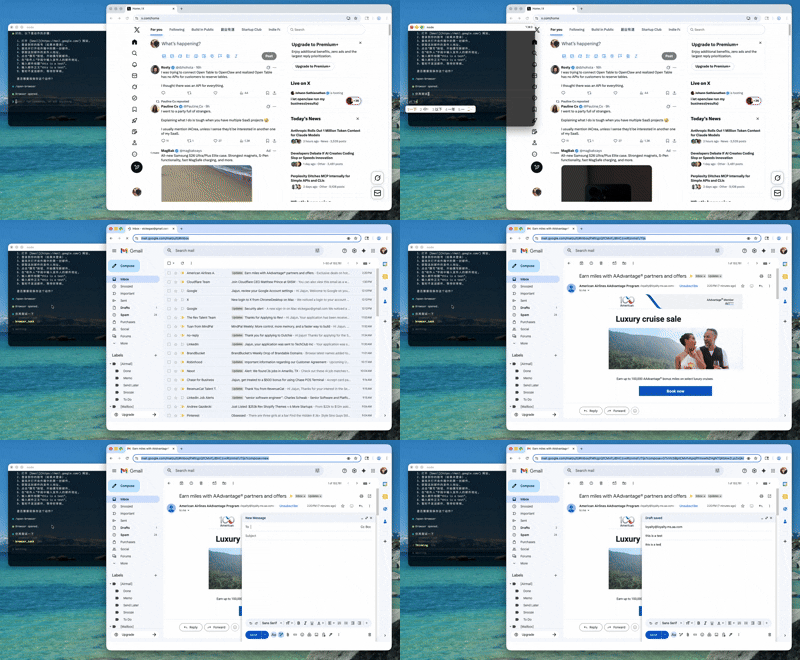
In this demo, I asked VibPage to open my Gmail, find the first email’s sender, and automatically send them a test email. The entire process is fully automated — I just typed one command.
Why Pivot So Fast?
Because the project is open source. The code is right there. If the direction is wrong, just change it.
A lot of indie developers make this mistake: they can’t let go because of sunk costs. “But I already wrote so much code,” “I already published a blog post about it,” “I already registered the domain” — none of these are reasons to keep walking the wrong path.
VibPage is still the same project, the same codebase, the same GitHub repo. The direction just shifted — from content automation to web automation. The underlying tech (AI + browser control) was always the same.
What’s Next
After the pivot, VibPage will focus on these scenarios:
- Email automation — auto-classify, reply, forward
- Form filling — auto-login, auto-submit
- Data monitoring — scheduled page change detection with notifications
- Social media — auto-post, auto-like, auto-reply
The project remains fully open source under the AGPL-3.0 license.
- Website: vibpage.com
- GitHub: github.com/eickegao/vibpage
One Last Thing
Publishing about content automation yesterday and pivoting to web automation today — looks like a face-slap, but I think it’s exactly the right move.
Instead of grinding away on a “meh” direction, validate fast and adjust fast. Startups call it “fail fast” — it applies to indie developers just as much.
Getting the direction wrong isn’t scary. What’s scary is knowing it’s wrong and still convincing yourself it’s fine.