
Just Finished My Hustle Fund Angel Investor Interview — Here's What I Learned
The interview I had at noon today just wrapped up. While it’s still fresh, I wanted to jot down some notes.
In my earlier post, I wrote about why I wanted to get into angel investing. This post is about what I actually learned regarding Hustle Fund and Angel Squad.
The Hustle Fund Story
Hustle Fund was actually started by a few Stanford students. Early on, they invested in Webflow — yes, the well-known no-code website builder. That bet turned out to be very successful.
After that success, they came up with a new idea: Syndicate Investing.
Put simply — instead of letting a handful of wealthy people invest quietly on their own, why not bring in a large group of smaller investors and have the fund team guide them to invest together?
It’s kind of like “crowdfunding with professional guidance”: you don’t have to source deals, make judgments, or place bets entirely on your own. Instead, you follow an experienced team and participate in a batch of early-stage projects with relatively small checks.
What Is Angel Squad?
Angel Squad is a community of investors that partners with Hustle Fund.
Its core value isn’t really “letting you invest” — it’s: teaching you how to invest.
The community regularly runs events that walk members through how Hustle Fund internally thinks about investment decisions. This is what I find especially compelling — it’s not about sending you a few deals and asking for your money, it’s about handing you a full methodology for making judgments.
During the interview, they shared Angel Squad’s learning framework, which breaks down into three tiers:
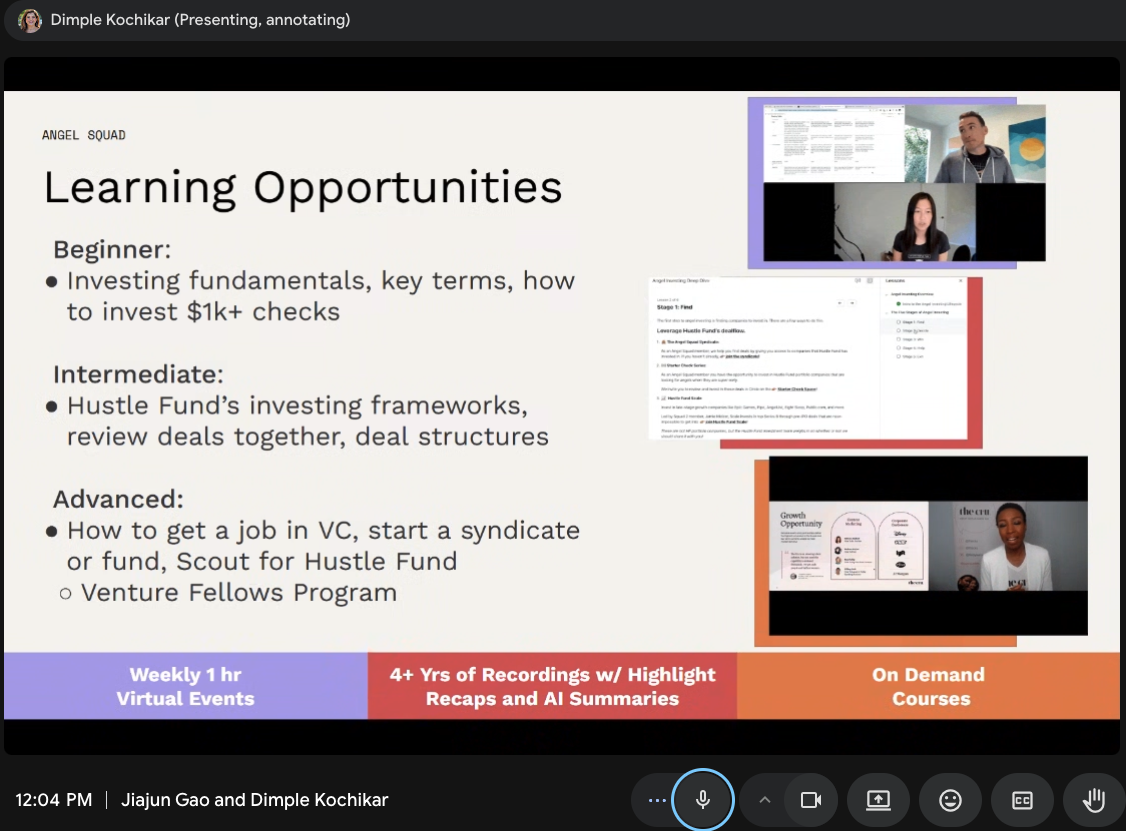
- Beginner: Investing fundamentals, key terms, how to write your first $1k+ check
- Intermediate: Hustle Fund’s investing frameworks, reviewing deals together, deal structures
- Advanced: How to get a job in VC, how to start your own syndicate or fund, how to Scout for Hustle Fund, and the Venture Fellows Program
On top of that, there are weekly 1-hour virtual events, 4+ years of recordings with highlight recaps and AI summaries, and on-demand courses.
Honestly, when I saw this curriculum, my first thought was — this isn’t just a “here are some deals, go invest” kind of club. It’s a full-fledged “investor growth path.” For someone coming from a technical background starting from zero, it’s exactly what I need.
The Numbers Are Interesting
During the interview, I asked about their operating metrics, and the numbers were pretty striking:
- Hustle Fund receives roughly 1,000 investment applications per month.
- They shortlist about 40 for interviews.
- After interviews, they invest in about 5 companies.
- Later, they’ll do a second round of investment in 3 of those 5.
1000 → 40 → 5 → 3.
That’s a very steep funnel. In other words, the Hustle Fund team is reviewing projects, filtering them, and making decisions at an intense pace every month. Angel Squad members are essentially watching and learning alongside this team.
For someone with a technical background, this volume and quality is an incredibly rare learning resource. You simply cannot see this many early-stage projects on your own in a year.
Pricing and Membership
Joining Angel Squad costs about $5,800, with an installment payment option available.
If you pay in full upfront, there’s a 33% discount.
Honestly, that’s not cheap. But if you view it as a combination of “education + community + deal flow” rather than just a membership fee, the value calculation looks completely different.
My current thinking: this fee is essentially a year of tuition. If over that year I genuinely learn how to evaluate early-stage projects, see enough deals, and meet enough people, then it’s worth it. Even if I don’t end up making money on any particular investment, the knowledge and relationships themselves have value.
My Next Step
I plan to try it for two weeks first.
During that time, I’ll actually participate in their community events, look at the investment cases they share, and get a feel for the internal discussion dynamics. If the experience matches my expectations, I’ll most likely officially join.
There’s something I’ve always believed — when it comes to an unfamiliar field, thinking about it isn’t enough. You have to step inside and see for yourself. Spending two weeks experiencing it firsthand beats a year of reading the website from the outside.
Some Initial Impressions
After the interview, my first impression of this organization is that it’s pretty pragmatic:
- It’s not a course-selling operation. Its core value is real deal flow and investment methodology, not a packaged content product.
- The barrier isn’t too high. Compared to the closed circles of traditional VCs, Angel Squad is relatively open to everyday investors.
- The learning aspect is strong. Hustle Fund is willing to share their deal-evaluation methodology with the community, which I think is rare.
Of course, this is just a first impression. The real judgment will have to wait until after my trial period.
Final Thoughts
During the interview today, I suddenly realized something: over these past years I’ve been writing code and building products, but my understanding of “how money flows, how projects get funded, how early-stage investment decisions get made” — that’s actually pretty shallow.
Going from being a pure builder to starting to understand the capital dynamics behind builders — that in itself is a learning process worth investing in.
As for whether I’ll end up investing in some amazing project, I don’t know. But at least this current step feels right.
That’s my take right after the interview. I’ll come back with an update once the trial period is over.